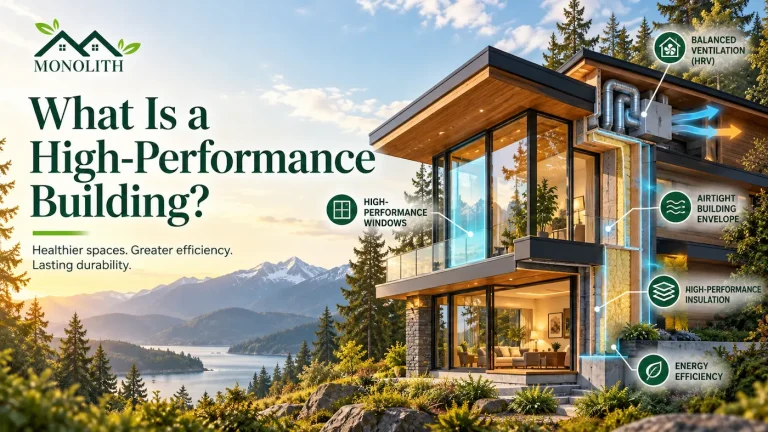
A high-performance building is one that integrates and optimizes energy efficiency, durability, life-cycle cost, and occupant health and comfort together, rather than improving one attribute at the expense of the others. The idea took shape in US federal legislation and building-science guidance in the mid-2000s, and it has since spread into codes, rebate programs, and marketing material across North America. That spread is the problem. “High-performance” now appears on brochures for buildings that have never been tested, so owners, developers, and buyers need a way to separate a claim from a measured result.
Why “High-Performance” Has No Single Definition
There is no single rulebook called “high-performance.” The term covers a family of standards, rating systems, and code pathways, each with its own targets. Some focus almost entirely on energy, while others add water, materials, or occupant wellness.
It also differs from “green building.” Green building is primarily concerned with environmental impact. High-performance building is concerned with operational results that can be measured, such as how much energy the building actually uses, how much air leaks through its envelope, and how comfortable it is to occupy. This is one reason the industry has gradually moved away from “green” toward “high-performance”: a performance target can be tested, while a general environmental intention cannot.
In practice, high-performance is a spectrum. At one end sit buildings that simply exceed code minimum by a meaningful margin. At the other end sit buildings designed to rigorous standards such as Passive House design, where heating demand and airtightness targets are among the strictest in the world, and Net Zero homes, which are designed to produce, or be ready to produce, as much energy as they consume over a year. Both are high-performance buildings, but high-performance does not automatically mean either one.
The Five Attributes of a High-Performance Building
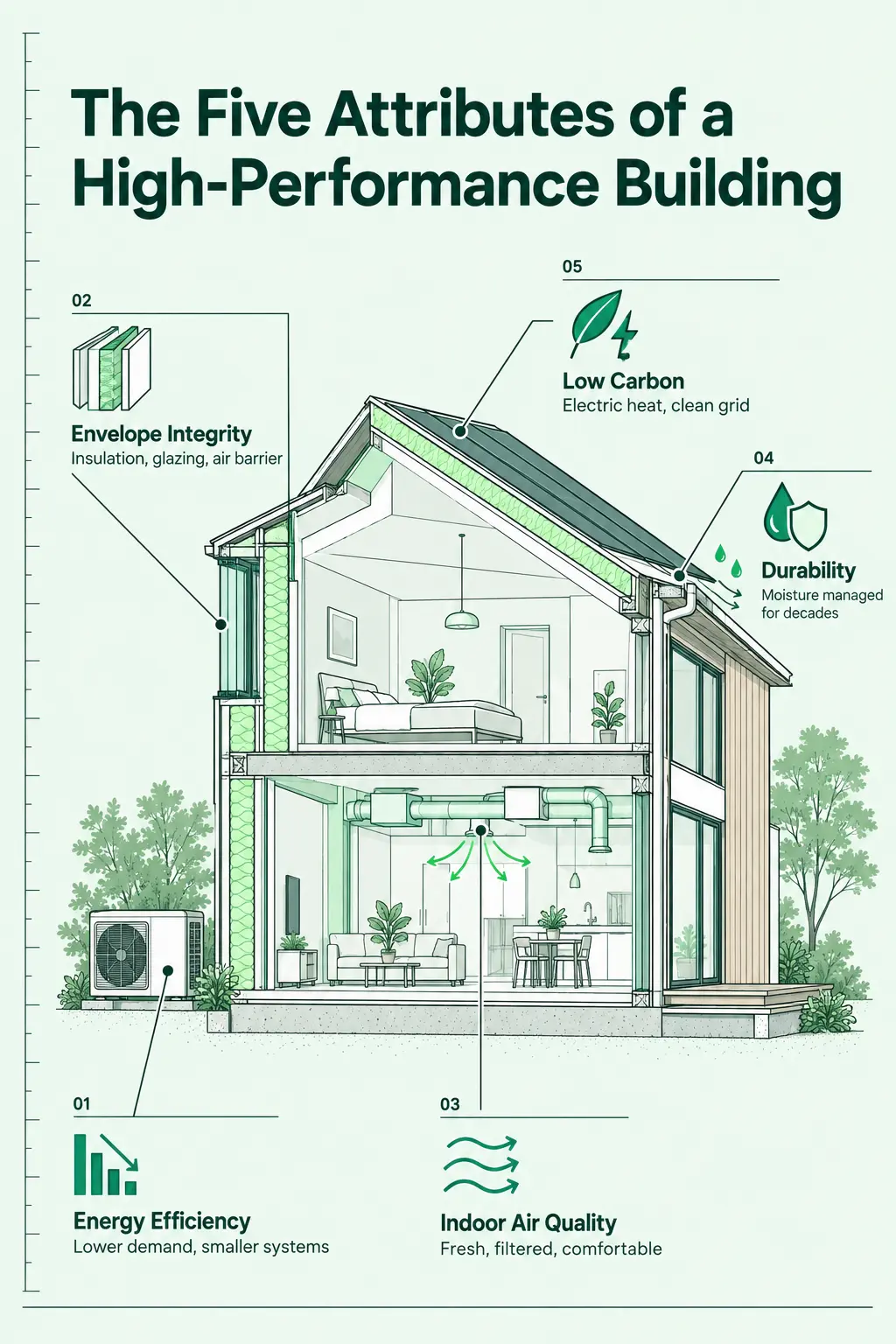
Whatever standard a project follows, a high-performance building is judged on five separate attributes. Each one can succeed or fail independently of the others.
Energy Efficiency
A high-performance building uses significantly less energy than a code-built equivalent, in both modelled and actual operation. The largest gains usually come from reducing the heating and cooling load in the first place, so that smaller, more efficient mechanical systems can do the remaining work.
Envelope Integrity
The building envelope is the physical barrier between inside and outside. In a high-performance building it combines continuous insulation, high-performance glazing selected for the right solar heat gain and heat loss values, and a continuous air barrier with sealed transitions at windows, roofs, and penetrations.
Indoor Environmental Quality
This attribute covers how the building feels to occupy. It includes a steady supply of fresh, filtered air, typically delivered through heat recovery ventilation, even temperatures without drafts or cold surfaces, good daylight, and reduced noise from outside thanks to better insulation and windows.
Durability and Moisture Control
A high-performance envelope must manage moisture as well as heat and air. When vapour and water movement are controlled, insulation stays dry, framing stays sound, and the building keeps performing for decades rather than degrading within a few years of occupancy.
Low Carbon Operation
Energy efficiency measures how much energy a building uses. Carbon measures what that energy emits. A high-performance building typically pairs a low energy demand with low-carbon heating and hot water, which in BC usually means electric heat pumps supplied by a largely renewable grid.
High-Performance vs. Code-Built vs. Net Zero
The three categories are often confused. The difference lies in the target and in how strictly the result is verified:
| Code-built | High-performance | Net Zero / Net Zero Ready | |
|---|---|---|---|
| Energy target | Code minimum | Well above code minimum | Produces, or is ready to produce, the energy it uses |
| Airtightness | Tested against the code minimum | Tested against a stricter target | Very tight, often approaching Passive House levels |
| Verification | Required permit documents | Energy modelling plus on-site testing | Modelling, testing, and often third-party certification |
Net Zero is one destination within the high-performance category, not a synonym for it. A building can be genuinely high-performance without ever installing solar panels or pursuing a Net Zero label.
What High-Performance Means in BC
BC gives the term more concrete meaning than most jurisdictions. The BC Energy Step Code sets progressively stricter energy targets for new buildings, and its upper steps are where high-performance becomes measurable. For Part 9 buildings, Steps 4 and 5 sit well above the current provincial minimum, and Step 5 is broadly equivalent to Net Zero Energy Ready performance.
Carbon is handled separately through the Zero Carbon Step Code, which runs from EL-1 (measure and report emissions) to EL-4 (zero carbon performance). A project can meet a high energy step and still fall short on carbon if its heating or hot water system does not qualify, so both requirements are best set together at the start of design.
For homebuyers, BC Housing publishes a consumer guide to high-performance homes that explains these features in plain language.
How Performance Is Verified, Not Claimed
A building does not become high-performance because of its specification sheet. It earns the label through results, checked at four points in the project:
- Design. Energy modelling sets the performance target and tests design decisions before anything is built, when changes cost the least.
- Mid-construction. A mid-construction blower door test checks the air barrier while it is still exposed, so leaks can be found and sealed before drywall covers them.
- Completion. Final airtightness testing confirms the finished result. For multi-unit and commercial projects, large building airtightness testing uses procedures scaled to the size and complexity of the enclosure.
- Post-occupancy. Infrared thermal imaging and building commissioning confirm that the envelope and mechanical systems are performing as designed once the building is in use.
Where Performance Gets Lost
Most high-performance projects that fall short do not fail because of the design target. They fail in the gap between design and construction.
- Late product substitutions. A window, insulation product, or heat pump is swapped during construction for availability or cost reasons, and the energy model is never updated. The building on paper and the building on site quietly drift apart.
- Air barrier discontinuities. The air barrier material itself usually performs well. The leaks occur at transitions and penetrations, where membranes meet window frames, roof assemblies, and service openings.
- Uncommissioned mechanical systems. Ventilation and heating equipment can run without running as designed. Without commissioning, airflow rates, controls, and settings are rarely checked against the design intent.
Conclusion
A high-performance building is defined by measurable outcomes across energy, envelope, indoor environment, durability, and carbon, and confirmed through testing rather than stated in a brochure. Monolith Housing Solutions supports builders, developers, and homeowners through that process, from energy modelling and BC Energy Step Code compliance to airtightness testing, thermal imaging, and commissioning. The work is led by founder Shahin Arvandi, a CHBA Net Zero Energy Advisor, Certified Air Tester and Level II Certified Thermographer who reviews each project against both its energy targets and its verified results.
Frequently Asked Questions
Definition
- What makes a building high-performance? A building is high-performance when it measurably outperforms code minimum across energy efficiency, envelope quality, indoor environmental quality, durability, and carbon, and when those results are confirmed through modelling and on-site testing.
- Is a high-performance building the same as a green building? Not exactly. Green building focuses on reducing environmental impact. High-performance building focuses on measured operational results. The two overlap, but a high-performance claim can be tested in a way a green claim often cannot.
- Who defines what a high-performance building is? No single body does. The term covers a range of standards, rating systems, and code pathways. In BC, the upper steps of the BC Energy Step Code provide the most practical measurable definition.
Attributes and Features
- What is a high-performance building envelope? It is an envelope that combines continuous insulation, high-performance windows, a continuous air barrier, and effective moisture control, so that heat, air, and water movement are all managed together.
- Do high-performance buildings need heat recovery ventilation? In most cases, yes. An airtight envelope needs a controlled fresh air supply, and heat recovery ventilation provides it while recovering much of the heat that would otherwise be lost.
- Are high-performance homes healthier to live in? They are typically designed for better indoor air quality, more even temperatures, and less outside noise, which together support a healthier and more comfortable indoor environment.
Comparison and Standards
- Is a high-performance home the same as a Net Zero home? No. Net Zero is one of the highest forms of high-performance building. Many high-performance homes exceed code by a wide margin without reaching Net Zero.
- What certifications apply to high-performance buildings? Common examples include Passive House, CHBA Net Zero, and LEED, alongside code-based pathways such as the upper steps of the BC Energy Step Code.
- How does Passive House relate to high-performance building? Passive House is one of the most demanding high-performance standards, with strict limits on heating demand and airtightness that are verified by testing.
Cost, Verification, and BC Context
- Does a high-performance building cost more to build? Upfront costs are often somewhat higher, mainly for insulation, windows, and air sealing, but they are offset over time by lower energy bills, smaller mechanical systems, and available rebates.
- How is a building proven to be high-performance? Through energy modelling at design, blower door testing during and after construction, and post-occupancy checks such as thermal imaging and commissioning.
- Which BC Energy Step Code step counts as high-performance? The upper steps, Steps 4 and 5 for Part 9 buildings, are generally considered high-performance, with Step 5 broadly equivalent to Net Zero Energy Ready.